
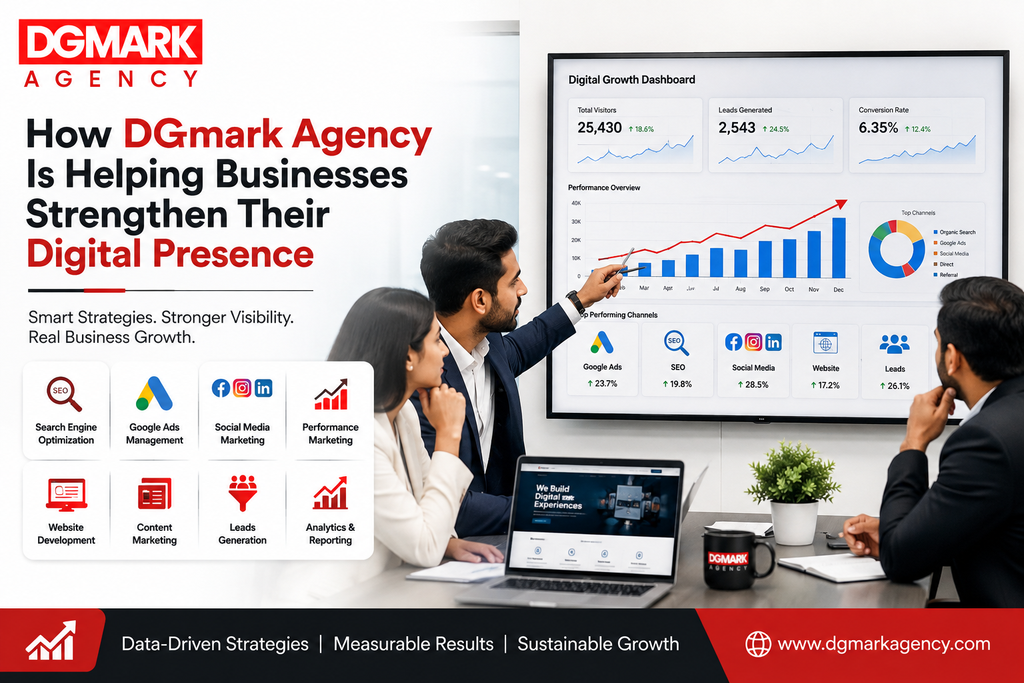
Building a strong digital presence is no longer something businesses can treat as optional. Customers search on Google, compare brands on social media, visit websites, read reviews, and interact with online ads before making purchasing decisions. If a business is difficult to find online—or fails to build trust when people do find it—it can lose opportunities to competitors.
This shift has made digital marketing an important part of modern business growth. However, simply having a website or posting regularly on social media does not automatically produce results. Businesses need a coordinated strategy that connects visibility, credibility, traffic, engagement, and conversions.
This is where DGmark Agency focuses its efforts. By combining areas such as search engine optimization, social media marketing, performance marketing, website development, and digital strategy, the agency helps businesses create a more structured online presence.
For companies searching for a Digital Marketing Agency in Mumbai, the important question is not simply which services an agency offers. The real question is how those services work together to support measurable business objectives.
Why a Strong Digital Presence Matters for Modern Businesses
A digital presence represents how a business appears and communicates across online platforms. It can include a company website, Google search visibility, social media profiles, paid advertisements, online reviews, business listings, and content.
The customer journey has become increasingly digital. A potential customer may first discover a business through an Instagram post, later search its name on Google, visit its website, compare its services with competitors, and finally submit an enquiry.
This means every digital touchpoint contributes to the customer’s perception of the brand.
Digital Visibility Influences Buying Decisions
Imagine two local businesses offering similar services. The first has an optimized website, active social media pages, informative content, positive reviews, and strong Google visibility. The second has an outdated website and very little online information.
Even before contacting either company, customers may perceive the first business as more established and trustworthy.
This illustrates why working with a Digital Marketing Agency in Mumbai can go beyond generating website traffic. A comprehensive strategy can also help businesses improve how potential customers perceive and interact with their brand.
Actionable Tip
Search your business name and your main services on Google. Then evaluate what a potential customer sees.
Check whether your:
- Website appears correctly.
- Google Business Profile contains updated information.
- Social profiles look active.
- Contact details are consistent.
- Website works properly on mobile devices.
- Brand messaging is clear across platforms.
This simple audit can reveal gaps that may be affecting your online credibility.
How DGmark Agency Takes an Integrated Approach to Digital Marketing
One challenge businesses often face is fragmented marketing. SEO may be handled separately from social media, while paid advertising and website development operate without a common strategy.
An integrated approach connects these activities around shared business goals.
For example, SEO can increase organic visibility, social media can strengthen brand awareness, paid campaigns can generate targeted traffic, and a conversion-focused website can turn that traffic into enquiries.
DGmark Agency’s approach to digital marketing brings these areas together rather than treating every channel as an isolated activity.
Connecting Marketing Activities With Business Objectives
Effective marketing begins with understanding what the business actually wants to achieve.
A startup may need brand awareness. A local service provider may want more phone calls. An established company may need qualified leads, while an e-commerce business may focus on online sales.
A Digital Marketing Agency in Mumbai should therefore avoid using exactly the same strategy for every client.
Before investing heavily in campaigns, businesses should define measurable objectives such as:
- Increase qualified website enquiries.
- Improve visibility for high-intent search terms.
- Generate more phone calls.
- Increase online purchases.
- Reduce cost per lead.
- Improve conversion rates.
These objectives make it easier to evaluate whether marketing activities are contributing to business growth.
Strengthening Organic Visibility Through SEO
Search engine optimization remains an important component of long-term digital visibility. When customers actively search for a product or service, appearing prominently in relevant search results can connect businesses with people who already have a level of purchase intent.
DGmark Agency can use SEO strategies to strengthen website visibility for relevant searches while improving the overall quality and usability of website content.
Keyword Research Based on Search Intent
Effective SEO is not about adding the same keyword repeatedly throughout a page. Modern optimization requires understanding why someone is searching.
Search intent can generally involve informational, commercial, navigational, or transactional needs.
For example, someone searching for “what is SEO?” is probably looking for information. A person searching for “SEO services near me” may be much closer to contacting a provider.
A strategic Digital Marketing Agency in Mumbai can identify these differences and develop content around searches that align with the customer’s journey.
On-Page SEO and Content Optimization
After identifying relevant search opportunities, individual website pages need to communicate their purpose clearly to both users and search engines.
This can involve optimizing:
- Page titles and meta descriptions.
- Heading structures.
- Internal links.
- URLs.
- Images.
- Service-page content.
- Calls to action.
- Topic coverage.
Content should answer genuine customer questions rather than being written only to insert keywords.
For instance, a service page explaining the process, benefits, common concerns, expected outcomes, and FAQs is generally more useful than a thin page filled with repeated search phrases.
Technical SEO and Website Performance
SEO also depends on the technical quality of a website.
Slow loading times, broken links, poor mobile usability, confusing navigation, or indexing problems can affect both user experience and search performance.
Businesses can start by reviewing their websites using tools such as Google Search Console and PageSpeed Insights. Identifying technical problems early can prevent them from limiting the impact of content and SEO campaigns.
Building Brand Awareness Through Social Media Marketing
Social media has changed how businesses communicate with their audiences. Platforms such as Instagram, Facebook, and LinkedIn allow brands to remain visible, educate potential customers, demonstrate expertise, and develop ongoing relationships.
However, consistent posting alone is not a strategy.
DGmark Agency can help businesses approach social media with clear content objectives rather than publishing random posts.
Creating Content With a Purpose
A useful social media strategy normally includes different content categories.
Educational content can answer common customer questions. Trust-building content can include testimonials, results, behind-the-scenes insights, or case studies. Engagement content can encourage conversations, while promotional content can introduce specific services or offers.
For example, a financial consulting business might publish educational content about tax planning, short videos addressing common financial mistakes, client success stories, and service-focused posts encouraging consultation enquiries.
This creates a stronger content ecosystem than repeatedly posting sales messages.
Maintaining Brand Consistency
Customers may encounter a company on several platforms before making contact. Consistent visual identity, messaging, tone, and positioning help make the brand easier to recognize.
A Digital Marketing Agency in Mumbai can support this consistency by coordinating creative design, content planning, campaign messaging, and brand communication across channels.
Businesses can apply the same principle internally by creating basic brand guidelines covering:
- Logo usage.
- Brand colors.
- Typography.
- Communication style.
- Visual templates.
- Key brand messages.
Even a simple guideline document can significantly improve consistency.
Using Performance Marketing to Reach High-Intent Audiences
Organic marketing builds long-term visibility, but businesses often need faster and more targeted customer acquisition. Performance marketing can help by placing advertisements in front of carefully selected audiences.
Google Ads can reach people actively searching for specific services, while Meta advertising can help businesses reach audiences based on interests, demographics, behaviours, and campaign signals.
The objective, however, should not be to generate the maximum number of clicks. It should be to generate valuable actions at a sustainable cost.
Focusing on Conversion Quality
Suppose Campaign A generates 100 leads at ₹200 per lead, while Campaign B generates 50 leads at ₹300 per lead.
Campaign A initially appears stronger. But if only five of its leads become qualified opportunities while 20 leads from Campaign B are qualified, Campaign B may provide greater business value.
This is why businesses should monitor metrics beyond clicks and impressions.
Useful performance indicators include conversion rate, cost per lead, lead quality, cost per acquisition, return on advertising spend, and ultimately revenue generated.
An experienced Digital Marketing Agency in Mumbai should connect advertising metrics with real business outcomes wherever tracking data makes this possible.
Turning Website Visitors Into Potential Customers
A website is often the central point of a company’s digital presence. SEO, social media, and paid advertising can all send visitors to it, but those marketing efforts lose value if the website does not encourage users to take the next step.
A strong business website should quickly answer three questions:
What does this company offer?
Why should I trust it?
What should I do next?
DGmark Agency’s website development and marketing efforts can work together to make these answers easier for visitors to understand.
Conversion-Focused Website Elements
Businesses should review whether their websites include clear service information, visible calls to action, mobile-friendly layouts, trust signals, simple contact forms, easy navigation, and fast-loading pages.
For example, someone arriving from a Google Ad for SEO services should ideally reach a page specifically explaining the SEO offering rather than a generic homepage with multiple unrelated options.
Matching landing-page content with visitor intent can create a smoother path from click to enquiry.
Creating a Connected Digital Growth System
The biggest advantage of combining SEO, social media, advertising, content, and website optimization is that each channel can support the others.
SEO can bring consistent organic traffic. Social media can keep the brand visible. Performance campaigns can accelerate customer acquisition. Content can educate prospects. The website can convert attention into enquiries.
Instead of viewing these as separate services, businesses can treat them as parts of one digital growth system.
This integrated mindset is especially valuable for businesses evaluating a Digital Marketing Agency in Mumbai because sustainable digital growth rarely comes from relying on a single channel.
Using Data and Analytics to Improve Marketing Performance
One of the biggest advantages of digital marketing is measurability. Unlike many traditional marketing methods, digital campaigns allow businesses to understand how users discover their brand, interact with their website, and complete important actions.
DGmark Agency can use performance data to identify what is working, what needs improvement, and where marketing budgets can be used more effectively.
For businesses choosing a Digital Marketing Agency in Mumbai, this data-driven approach is important because successful marketing should not depend entirely on assumptions.
Tracking Metrics That Actually Matter
Businesses often focus heavily on impressions, followers, likes, and website traffic. These numbers can provide useful context, but they do not always indicate business growth.
More meaningful metrics may include:
- Website conversions
- Qualified leads
- Cost per lead
- Conversion rate
- Cost per acquisition
- Organic search visibility
- Phone calls and form submissions
- Return on ad spend
- Customer acquisition cost
For example, increasing monthly website traffic from 5,000 to 10,000 visitors sounds impressive. However, if enquiries remain unchanged, the additional traffic may not be reaching the right audience.
A better goal is to attract relevant visitors and improve the percentage who take valuable actions.
Actionable Tip: Build a Simple Monthly Dashboard
Business owners do not need to track dozens of metrics every day. Instead, create a monthly dashboard containing five to ten KPIs directly connected with business objectives.
Compare these figures month over month to understand whether your digital strategy is moving in the right direction.
Helping Local Businesses Improve Their Online Visibility
For many Mumbai businesses, attracting customers from relevant geographic areas is more valuable than generating traffic from across the country.
A clinic, restaurant, training institute, real estate consultant, financial advisor, or local service provider usually needs customers from specific locations.
This makes local digital marketing particularly important.
A Digital Marketing Agency in Mumbai can develop strategies around local search behaviour, location-specific content, Google Business Profile optimization, local advertising, and relevant keywords.
Optimizing for Local Search
Imagine someone searching Google for a service followed by a location. That user is often looking for a business they can contact relatively soon.
Businesses can strengthen local visibility by maintaining accurate information across their website and business listings.
Important details include:
- Business name
- Phone number
- Location
- Opening hours
- Service areas
- Customer reviews
- Website information
- Relevant photos
Location-specific service pages can also be useful when a business genuinely serves multiple areas.
However, creating dozens of nearly identical pages and simply replacing the location name is unlikely to provide a good user experience. Each page should offer meaningful information relevant to customers in that area.
Building Trust Through Useful and Relevant Content
Customers rarely make decisions based on advertising alone. They research businesses, compare alternatives, read content, check reviews, and look for evidence of expertise.
Content marketing helps businesses answer these questions before a sales conversation begins.
DGmark Agency can support this process through blogs, website content, social media posts, educational resources, campaign creatives, and other forms of communication.
Content Should Solve Problems Before Selling Services
A common mistake is making every piece of content promotional.
Suppose a business provides SEO services. Instead of repeatedly publishing “Buy our SEO package,” it could create content around topics such as:
- Why website rankings suddenly decline
- Common local SEO mistakes
- How long SEO can take
- SEO versus Google Ads
- How businesses can improve Google visibility
This type of content addresses questions potential customers already have.
When people consistently receive useful information from a brand, familiarity and credibility can grow naturally.
For a Digital Marketing Agency in Mumbai, content therefore serves multiple purposes. It can contribute to SEO, educate potential customers, support social media activity, strengthen expertise, and help move prospects closer to an enquiry.
Creating Strategies for Different Stages of Business Growth
Digital marketing is not one-size-fits-all.
A newly launched startup and an established company may use the same platforms but require completely different strategies.
Startups and New Businesses
New businesses usually need visibility and initial customer acquisition.
Their priorities may include developing a professional website, establishing social media profiles, setting up analytics, building initial SEO foundations, and testing paid campaigns.
Instead of investing heavily across every platform immediately, startups can identify one or two channels where their target audience is most active and build from there.
Small and Local Businesses
Local businesses may benefit more from location-focused SEO, Google Business Profile optimization, customer reviews, lead-generation advertising, and highly targeted landing pages.
For these businesses, reaching 1,000 highly relevant local prospects can sometimes be more valuable than reaching 100,000 people with little interest in the service.
Growing and Established Companies
More established businesses may focus on scaling successful campaigns, expanding organic visibility, improving conversion rates, entering new markets, developing stronger content systems, and reducing customer acquisition costs.
This is another reason businesses may work with a Digital Marketing Agency in Mumbai rather than following a fixed marketing package. Strategies can evolve as business priorities change.
Combining SEO and Paid Advertising for Balanced Growth
Businesses sometimes treat SEO and paid advertising as competing strategies. In practice, they can complement each other.
SEO generally focuses on developing long-term organic visibility, while paid advertising can provide faster access to targeted audiences.
For example, a company launching a new service may use Google Ads to generate immediate visibility while simultaneously building SEO content around relevant search terms.
Over time, organic rankings may become another important source of traffic and leads.
This creates a more diversified acquisition strategy.
Practical Application
A business could structure its marketing into three stages:
Stage 1: Immediate Visibility
Use paid campaigns to test keywords, audiences, offers, and landing pages.
Stage 2: Organic Development
Build optimized service pages, helpful blogs, local SEO assets, and authority around important topics.
Stage 3: Continuous Optimization
Use data from both organic and paid channels to improve messaging, conversion rates, targeting, and budget allocation.
This approach can help businesses avoid depending entirely on one source of traffic.
Why Continuous Optimization Matters
Digital marketing is not a campaign that can simply be launched and forgotten.
Search behaviour changes. Competitors introduce new campaigns. Advertising costs fluctuate. Website visitors behave differently. Platforms release new features and algorithms evolve.
Therefore, continuous improvement is essential.
DGmark Agency can evaluate campaign performance and make adjustments based on actual results rather than maintaining the same strategy indefinitely.
Small Improvements Can Produce Meaningful Results
Consider a landing page receiving 2,000 visitors per month with a conversion rate of 2%. It generates approximately 40 conversions.
If improvements to the headline, page structure, offer, form, and call to action increase the conversion rate to 3%, the same traffic could generate around 60 conversions.
That is 20 additional conversions without increasing website traffic.
This demonstrates why optimization deserves as much attention as traffic generation.
A results-focused Digital Marketing Agency in Mumbai should therefore consider both sides of the equation: bringing relevant users to a business and improving what happens after they arrive.
Practical Digital Marketing Tips Businesses Can Implement
Businesses do not need to change everything at once. A few focused improvements can provide a strong starting point.
- Audit your Google presence: Search your brand, services, and important location-based keywords to understand what potential customers see.
- Improve your website CTA: Every important page should provide a clear next step such as calling, requesting a quote, booking a consultation, or submitting an enquiry.
- Track conversions: Configure tracking for valuable actions instead of measuring success only through clicks and traffic.
- Create customer-focused content: Answer real questions customers ask during sales conversations and turn those answers into blogs, videos, FAQs, and social posts.
- Review marketing performance regularly: Identify which campaigns generate qualified opportunities and allocate resources accordingly.
These practices can help create a more structured approach regardless of the size of the marketing budget.
Conclusion
A strong digital presence is created through a combination of visibility, credibility, user experience, communication, and continuous optimization.
DGmark Agency helps businesses connect key digital marketing areas such as SEO, social media marketing, performance marketing, content, website development, and analytics into a more unified strategy.
For businesses evaluating a Digital Marketing Agency in Mumbai, the focus should go beyond simply finding an agency that offers multiple services. The more important factors are whether the strategy aligns with business objectives, reaches the right audience, generates measurable actions, and improves based on performance data.
Digital marketing works best when every channel has a clear purpose. SEO builds discoverability, social media supports visibility and engagement, paid campaigns reach targeted audiences, content develops trust, and an optimized website turns attention into action.
Businesses that approach these channels as parts of one connected system are better positioned to strengthen their digital presence and build sustainable online growth.
Frequently Asked Questions
1. What digital marketing services can DGmark Agency provide?
DGmark Agency focuses on digital marketing areas including SEO, social media marketing, performance marketing, website development, content strategy, and online growth. The appropriate combination depends on a business’s objectives, audience, competition, and existing digital presence.
2. Why should a business work with a Digital Marketing Agency in Mumbai?
A Digital Marketing Agency in Mumbai can help businesses develop coordinated strategies across search, social media, paid advertising, websites, and other digital channels. For Mumbai-focused businesses, understanding local audiences and geographic search behaviour can also be valuable.
3. How long does digital marketing take to produce results?
Timelines vary by channel. Paid advertising can begin generating traffic soon after campaigns launch, while SEO generally requires a longer-term approach. Competition, website quality, budget, targeting, and strategy can all influence results.
4. Is digital marketing useful for small businesses?
Yes. Small businesses can use local SEO, social media, Google Ads, Meta Ads, content marketing, and conversion-focused websites to reach relevant audiences. The strategy should be scaled according to the company’s goals and available budget.
5. How can businesses measure whether digital marketing is working?
Businesses should connect marketing activities with measurable outcomes such as qualified leads, sales, calls, form submissions, conversion rates, cost per acquisition, and return on advertising spend. Traffic and engagement metrics can provide additional context but should not be viewed in isolation.
name :- dgmark agency
add:- 405, 4th Floor, Pratik, Ratan Nagar Apartment-B Wing, Bus Stop, Near, Apna Bazar Rd, opp. Dhake Colony, D.N.Nagar, Andheri West, Mumbai, Maharashtra 400053
phone:- 7208148492
web:- https://dgmarkagency.com/